
Founder of Silver Loon Roofing and the Qualifying Person on its MN DLI Residential Building Contractor license. 35+ years in the trades across Minnesota lake country and central MN, with focused experience on residential roof replacement, insurance-claim storm work, ice dam remediation, and the attic-ventilation fixes that keep ice dams from coming back.
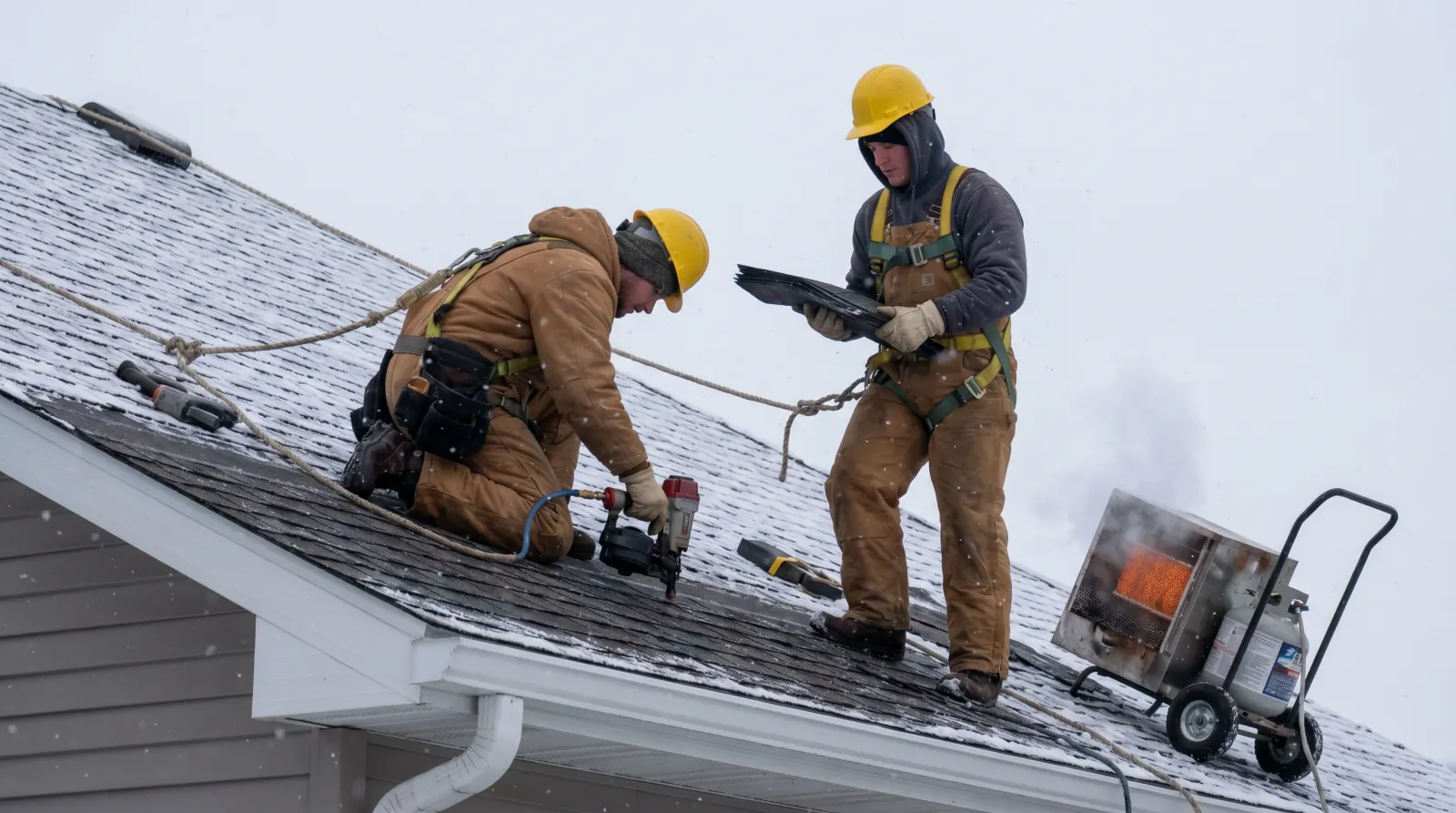
Yes, a residential roof can be replaced in a Minnesota winter — including in January in Brainerd or Nisswa — when the contractor follows specific cold-weather installation protocols. The practices differ meaningfully from warm-weather work, and not every roofing crew is equipped or willing to do it correctly. Here is what changes below 40°F and how to evaluate whether a contractor is doing it right.
Why Cold Weather Matters for Shingles
Asphalt shingles are designed to seal against one another after installation using a heat-activated adhesive strip on the underside of each shingle. In warm weather, the sun and ambient temperature activate this adhesive within days of installation, bonding each course to the course below. In cold weather — consistently below 40°F — this self-sealing process does not happen on its own.
This is the crux of the winter installation question. The shingles go down fine in the cold. The issue is the seal strip.
An unsealed shingle is not a failed shingle. It becomes a problem if wind works under it before sealing occurs, or if the installation is never hand-sealed and the roof enters a freeze-thaw season without the bond that wind resistance ratings depend on. A properly executed cold-weather installation addresses this by hand-sealing every course.
What Changes Below 40°F
Shingle Handling and Warming
Cold asphalt shingles become brittle and can crack if bent sharply. At temperatures below 40°F, shingle bundles must be kept warm — typically in a heated trailer or a propane-heated warming cart — until they are carried up and installed. A bundle that has been sitting outside in 10°F January air in Brainerd for two hours is a cracking risk.
Experienced cold-weather crews rotate bundles: warm ones go up, the next batch comes out of the trailer. The bundles on the roof get installed promptly, not left sitting. This rotation adds labor time but is not optional if you want undamaged material.

At temperatures below approximately 20°F, the risk of shingle cracking during installation rises sharply. We evaluate very cold conditions job by job — a 15°F still day with low humidity is manageable with the right preparation; a 15°F day with 30 mph wind gusts is not an appropriate installation day for any roofing material.
Hand Sealing
Every single shingle course must be hand-sealed in cold-weather installations. The process uses a dab of roofing cement — applied to the underside of the shingle above, at the tab bonding zone — to provide the adhesion that the heat-activated strip cannot produce on its own. A 1,800-square-foot roof involves several thousand individual shingles; hand-sealing each one adds hours to the installation time.
There is no shortcut here that produces an acceptable result. A cold-weather installation that skips hand sealing and relies on "it'll seal when it warms up in spring" is a warranty problem and a liability risk until spring. GAF's cold-weather installation specifications for Timberline HDZ explicitly require hand sealing below 40°F. A contractor who tells you hand-sealing is unnecessary in a Minnesota November or December does not meet manufacturer installation requirements.
Nailing Temperature
Pneumatic nailers drive nails at consistent depth regardless of temperature, but the shingle itself behaves differently when cold. Overdriven nails — which punch through the shingle surface rather than sitting flush — are more common in cold conditions because the brittle material tears under the nail head more easily. A good crew adjusts nailer pressure for cold-weather conditions and monitors nail depth throughout the day as temperature changes.
Manufacturer Warranty Compliance
GAF, Owens Corning, and other major shingle manufacturers specify minimum temperature requirements for installation in their warranty terms. For GAF Timberline HDZ, the cold-weather installation guidance specifies that hand sealing is required when temperatures are below 40°F during installation, and that special precautions are required below 32°F. Installation below specific temperature thresholds — GAF specifies not below 10°F for the product itself — voids the manufacturer's wind warranty unless proper cold-weather procedures were followed and documented.
This matters because: if your roof is installed in a Minnesota winter without documented cold-weather compliance, and it fails in a wind event before the seal strip activates in spring, the manufacturer's warranty dispute will focus on whether installation was within specification.
Ask your contractor specifically: "Will you hand-seal the shingles during cold-weather installation, and will you document it?" A straightforward yes is the right answer.
Underlayment and Ice and Water Shield in Cold Weather
Peel-and-stick ice and water shield — the self-adhering membrane installed at the eaves and in valleys — requires a minimum surface temperature for proper adhesion. Most products specify a minimum substrate temperature of 40–50°F for adequate bond, though some cold-temperature formulations extend this to 25°F.
In sub-zero conditions, ice and water shield can go down, but achieving the peel-back without the membrane tearing, and getting adequate contact with the deck, requires warming the membrane and the deck surface in some cases. This is the most temperature-sensitive component of a cold-weather installation.
Synthetic underlayment — which goes over the full deck above the ice and water shield zone — is less temperature-sensitive; it is mechanically fastened rather than adhesive, and most products perform adequately in cold conditions.
Why Do Winter Installations at All?
The practical reasons:
Emergency situations. If a wind event or falling tree has torn sections of the roof in November or December, waiting until spring is not a viable option. Emergency winter repairs and full replacements happen out of necessity.
Scheduling. Many Minnesota homeowners schedule fall replacements that push into November or December as contractor crews work through their season backlog. A competent crew that knows cold-weather protocols can execute these professionally.
Insurance claim timing. Insurance-funded replacements often process over the fall and early winter. When the claim is approved and the payment is released in November, waiting until April adds months of exposure risk to an already-damaged roof.
What Winter Installation Does Not Change
The structural quality of a properly executed cold-weather installation is equal to a warm-weather installation. The shingle material itself is identical. The deck preparation, ice and water shield coverage, underlayment, drip edge, and flashing work follow the same specifications. What changes is the handling, the sealing, and the pace — not the outcome.
A roof installed correctly in January in Brainerd will carry the same manufacturer warranty and perform the same as one installed in May, provided cold-weather protocols were followed. The "spring reveal" when temperatures rise and the seal strip finally activates is the same for both.
Frequently Asked Questions
What is the lowest temperature at which you will install a roof in Minnesota?
We evaluate each job individually, but as a practical guideline, we do not schedule installations on days forecast below 10°F. Between 10°F and 40°F, cold-weather protocols apply — warmed bundles, hand sealing, adjusted nailer pressure. Above 40°F, standard installation procedures apply. Wind speed matters as much as temperature: a 25°F calm day is more workable than a 32°F day with 25 mph sustained wind.
Does a winter installation void the manufacturer's warranty?
No — provided the manufacturer's cold-weather installation requirements are followed and documented. GAF, Owens Corning, CertainTeed, and other major manufacturers specify cold-weather procedures rather than prohibiting cold-weather installation. The warranty risk comes from skipping those procedures, not from installing in winter per se.
How long after a cold-weather installation before the shingles seal?
Hand-sealed shingles are bonded at installation — there is no waiting period. The self-seal strip in the shingle, which activates with heat, may not activate until spring, but the hand-sealed installation provides the required bond in the interim. Once temperatures consistently reach 50–60°F for several days, the seal strip activates and bonds as designed.
Should I wait until spring if I do not need a replacement urgently?
If your current roof has no active leaks and is structurally sound, scheduling a replacement for spring is a reasonable choice — spring installations are more comfortable for crews and marginally simpler in process. If you have an active leak, storm damage, or your insurance claim is already approved, addressing it now with proper cold-weather installation is the right call.
Is the cleanup harder in winter?
Yes, modestly. Magnetic nail sweeps work well in dry conditions but are less effective in deep snow. We stage cleanup to match conditions — clearing snow if needed before the magnetic pass — and do a final walk after the snow melts if the installation was in heavy winter conditions. Nail pickup is taken seriously regardless of season.
Have a winter roof emergency or a fall replacement that pushed into cold weather? We handle cold-weather installations in Brainerd, Nisswa, Crosslake, the Whitefish Chain, Gull Lake, and across the lake country we call home. Reach out at /contact/ or schedule an estimate — we will tell you honestly whether your situation is a go, and what the cold-weather protocol adds to the timeline.
Founder of Silver Loon Roofing and the Qualifying Person on its MN DLI Residential Building Contractor license. 35+ years in the trades across Minnesota lake country and central MN, with focused experience on residential roof replacement, insurance-claim storm work, ice dam remediation, and the attic-ventilation fixes that keep ice dams from coming back.
More from Jimmy →