
Roofing in Minneapolis, MN
Twin Cities Metro · Hennepin County
Silver Loon covers Minneapolis (Hennepin County): roof replacement, repair, storm damage, and ice dams. Based in Central Minnesota.
The April 2026 hail event dropped large hailstones across Minneapolis neighborhoods that do not think of themselves as storm country — Kingfield, Linden Hills, Northeast, all of it. Urban tree canopy does not stop hail, and bungalows near the Chain of Lakes are just as exposed as any suburban roof when a supercell tracks northeast across Hennepin County. If your home took that hit, the documentation window for a clean insurance claim is already shrinking.
Minneapolis has more pre-1950 housing than almost anywhere in Minnesota — beautiful stock, genuinely worth preserving, but built with original flashing details and attic assemblies that were never designed for today's insulation requirements. Ice dam season hits those homes every year. The fix is in the attic, not on the roof surface — and the inspection is where that conversation starts.
About Minneapolis, MN
Minneapolis is the largest city in Minnesota, with a 2024 population of approximately 428,579 residents spread across 83 officially recognized neighborhoods — each with its own character, housing era, and relationship to the weather that comes off the Chain of Lakes and the Mississippi Riverfront. The city straddles Hennepin County and sits at the center of the Twin Cities metro, connected south and west to its suburbs by I-35W, I-94, and MN-62. The Mississippi defines the eastern edge, with the Stone Arch Bridge — an 1883 railroad crossing repurposed as a pedestrian and cycling span — still carrying foot traffic above the St. Anthony Falls. In the Minneapolis Sculpture Garden near the Walker Art Center, the Spoonbridge and Cherry sculpture has anchored the city's public art identity since 1988: a 52-foot stainless steel spoon curving out of a reflecting pool, holding a 1,200-pound red cherry at its tip.
The city's 83 neighborhoods cover a wide range of character and density. North Loop sits just north of downtown, where converted warehouse buildings now hold apartments and restaurants — a neighborhood that redeveloped quickly after 2010 and carries a very different housing profile than the tree-canopied streets two miles south. Uptown, straddling the lakes district near Lake Calhoun and Lake of the Isles, mixes apartment towers on Hennepin Avenue with bungalow blocks a few streets over. Northeast Minneapolis, across the river from downtown, built its identity on Eastern European immigrant trades in the early twentieth century and now balances long-established residential streets against a commercial district that grew substantially after 2015. Kingfield and Linden Hills anchor the southwest, where the housing is older, the lots are larger, and the canopy cover makes summer look different from most of the city.
Minneapolis has a diverse population that includes significant Black, Hispanic, Asian, and Native American communities, with a history of community organizations and neighborhood associations that pay close attention to how contractors operate in their areas. We work across all 83 neighborhoods and treat every job the same way regardless of zip code: written estimate before anything starts, no additions after signing, permit pulled before the first crew member sets foot on a ladder.
Housing stock and market
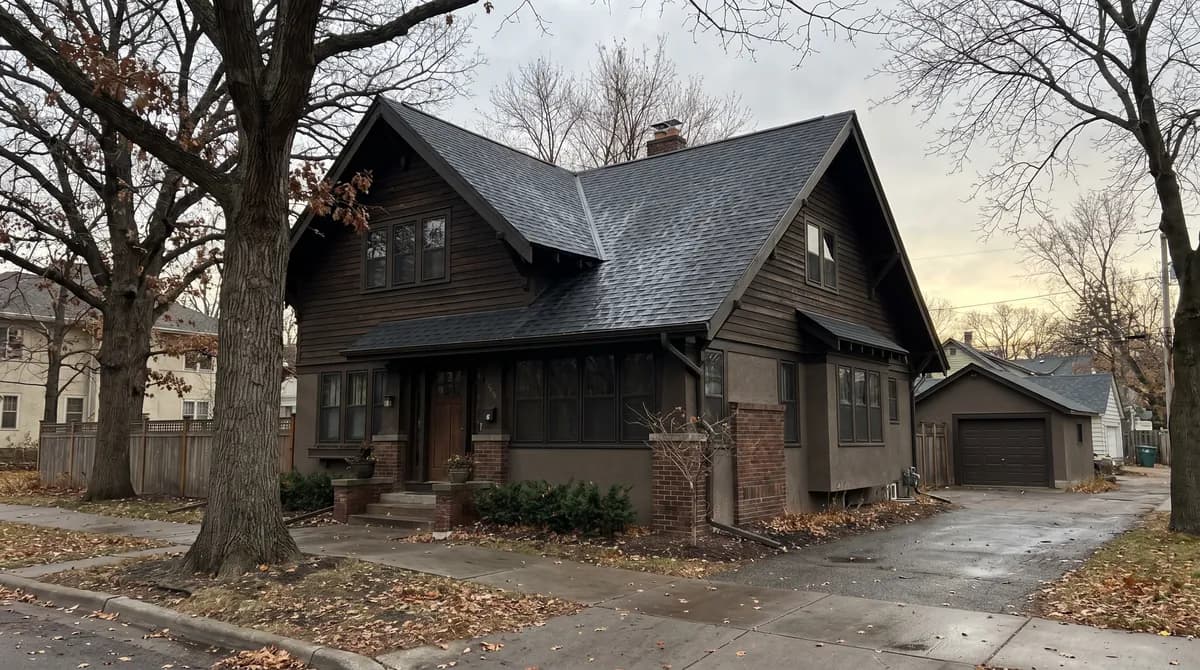
Minneapolis's housing stock reflects more than a century of residential construction layered on top of itself. The southwest neighborhoods — Kingfield, Linden Hills, Fulton, Lynnhurst — carry the highest concentration of pre-war housing: Craftsman bungalows built between 1905 and 1930, Victorian-era two-stories from the 1890s and early 1900s, and Tudor Revival homes from the 1920s that were the preferred style for buyers who wanted something that read as substantial. These homes have steeply pitched roofs, complex rooflines with dormers and hips, and original framing that was built to specification but has now been through 90 to 120 years of Minnesota freeze-thaw cycles. Attic insulation in most of them was either never installed to modern depths or was retrofitted incorrectly — packed against the rafters instead of laid over the joists — which creates the conditions for ice dams almost every winter.
Median home values in Minneapolis stabilized in the $350,000 to $365,000 range through 2024 and into 2025, though that number varies considerably by neighborhood. A Craftsman bungalow in Kingfield or a Tudor Revival in Linden Hills can list well above that median. The metro area as a whole continued steady growth driven by economic diversity, healthcare and technology employment, and the University of Minnesota's anchor role on the east bank. Modern development has added apartment towers and mixed-use buildings in North Loop, Uptown, and along University Avenue, but the majority of Minneapolis's residential square footage is still detached single-family housing built before 1970.
For roofing purposes, the pre-war homes are the most labor-intensive jobs in the city. Steep pitches mean more safety staging. Dormers mean more flashing runs. Historic or character-conservation district guidelines in parts of Linden Hills and Kingfield can restrict material choices or require matching profiles to preserve roofline character. We account for all of that before the estimate is written — nothing surfaces as a change order mid-project.
Weather and roof realities
Minneapolis averages 52 inches of annual snowfall, and the city's urban heat island does not insulate its residential neighborhoods from the freeze-thaw cycles that make ice dams a routine wintertime problem. From January through March, temperatures cross 32 degrees multiple times per week in a typical year. When attic heat escapes through an under-insulated deck, it warms the roof surface enough to melt snow; that meltwater runs down the slope, hits the cold eave overhang, and refreezes. The resulting ice dam backs standing water up the slope, and water under pressure will find any gap — a failed flashing joint, an unsealed nail penetration, a short ice-and-water-shield termination. On a Craftsman bungalow in Kingfield where the attic insulation has never been upgraded, this happens nearly every winter that brings meaningful snowfall.
Lake-effect moisture from the Chain of Lakes — Bde Maka Ska, Lake of the Isles, Lake Harriet, Cedar Lake — adds to the west- and north-facing slope exposure on homes in the lakes district. Roofs on the downwind side of those lakes accumulate drifted snow faster than the same roof profile on a block further east, and the moisture content of that snow is higher. Standing water on a low-pitch section of a complex Victorian roofline after a wet snowfall is one of the more reliable ways to find a slow leak that the homeowner attributed to condensation.
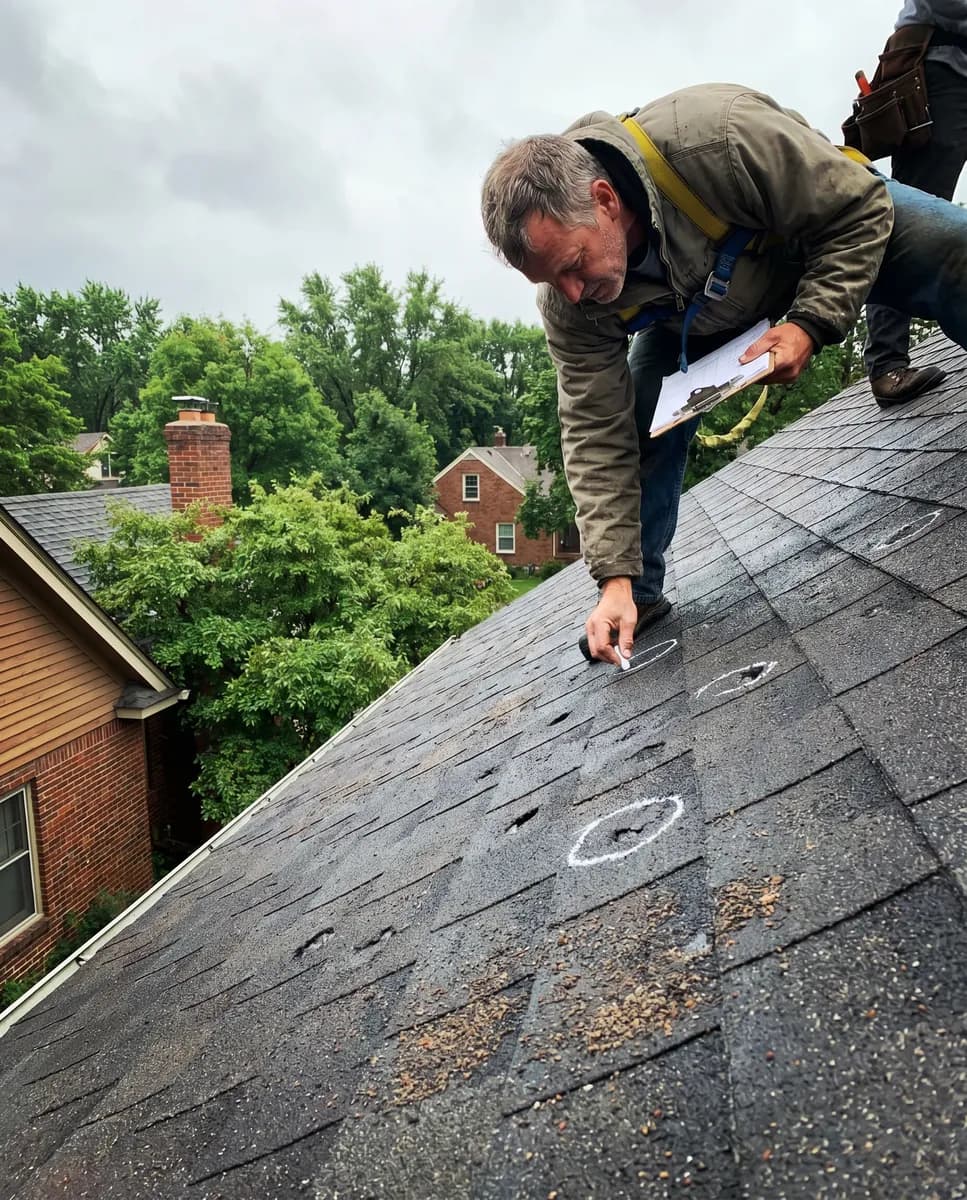
Summer brings severe thunderstorm risk across the Twin Cities metro. In April 2026, large hail crossed the metro area, hitting asphalt shingles at speeds that cause granule loss and mat bruising even when the stones are not large enough to punch through outright. Hail damage of that type does not show up clearly from the ground — you need someone on the roof, walking the field, checking the ridge caps and the flat sections near dormers where granule loss concentrates. Wind gusts during severe thunderstorm warnings regularly exceed 60 mph across Hennepin County, and the river corridor can funnel wind differently than inland neighborhoods. Impact-resistant Class 4 shingles are worth specifying on any Minneapolis replacement, both for the protection they provide through subsequent storm seasons and for the homeowners insurance discounts they can qualify for in Minnesota.
For Minneapolis homeowners who experienced the April 2026 hail event: we provide written post-storm inspections with photo documentation suitable for insurance claim submission. There is no charge for the inspection before a contract is signed, and we attend adjuster inspections to make sure nothing is missed or undervalued in the initial claim settlement. Storm damage claims in the Twin Cities market move faster when the contractor and the adjuster are looking at the same roof at the same time.

Residential Services
Roofing services in Minneapolis
We offer the full residential menu from our Central Minnesota base — the same crew, the same standards, across all 43 Minnesota cities we serve.
Replacement in Minneapolis
Full residential roof replacement with architectural shingles, metal, or specialty…
Replacement in Minneapolis→Repair in Minneapolis
Targeted roof repairs for Minnesota homes and cabins — leak diagnosis, flashing re…
Repair in Minneapolis→Storm Damage in Minneapolis
Hail and wind damage assessment, insurance claim support, and full restoration for…
Storm Damage in Minneapolis→Get in Touch
Contact Silver Loon Roofing — Minneapolis
- Serving
- Minneapolis, MN (Hennepin County)
- Phone
- (970) 555-0199
- Hours
- Mon–Fri 7 am – 6 pm
Sat 8 am – 2 pm
Dispatched from our Central Minnesota home office along the Rum River
Nearby areas we serve from Minneapolis
- Kingfield
- Linden Hills
- North Loop
- Uptown
- Northeast Minneapolis
Need roofing work in a nearby town? Request a free estimate — we cover the surrounding area without a travel surcharge.
Common Questions
Frequently asked questions — Minneapolis
Ready for a straight-talk roof estimate in Minneapolis?
We inspect, document, and give you a written line-item estimate before any work starts. No pressure, no surprises.